How one change to a car payment can help Americans get ahead of their debt


Car payments are one of the largest monthly obligations for most people, but they don’t happen in a vacuum. The average American is carrying debt across multiple categories at once. But their car loan may be the one lever they can pull to create more breathing room and get ahead of their debt. According to Caribou’s survey of 2,000 car loan borrowers, if they could save $150 a month on their car payment, 60% of respondents would use the savings to pay down other debt.
So how far can an extra $150 a month actually go? Saving on your car payment can create a positive ripple effect, freeing up money in your budget that can be sent toward the debt that’s costing you the most. This is becoming increasingly important as Americans currently carry $1.6 trillion in student loan debt and $1.2 trillion in credit card debt, according to the latest estimates from the Federal Reserve Bank of New York.
How to lower your monthly car payment by refinancing
Auto refinancing means replacing your current car loan with a new one, usually with a different rate, term, or lender. If you qualify for better terms, refinancing could lower your monthly payment and free up money you can put toward credit cards, personal loans, medical bills, or other higher-interest-rate debt you are carrying.
Refinancing may be worth considering if:
- Your current auto loan rate is higher than what you may qualify for now.
- Your credit has improved since you bought the car.
- Your monthly car payment is making it hard to pay other bills.
- You can lower your payment without adding too much extra interest.
Some people hesitate to check their rates because they’re afraid it could hurt their credit score. In fact, 33% of auto loan borrowers in Caribou’s survey say a potential negative impact on their credit score would keep them from refinancing. But checking refinance rates on sites like Caribou only requires a soft credit pull, which does not affect your credit score. A hard credit pull only happens when you select an offer and submit your application.
Compare the new loan against your current one side by side. A lower payment can help reduce monthly pressure, but a longer loan term may increase the total interest you pay. You can run the numbers using an auto refinance calculator.
How to use car savings to pay down high-interest debt
Lowering your car payment is only half the strategy. The other half is deciding where the freed-up money should go.
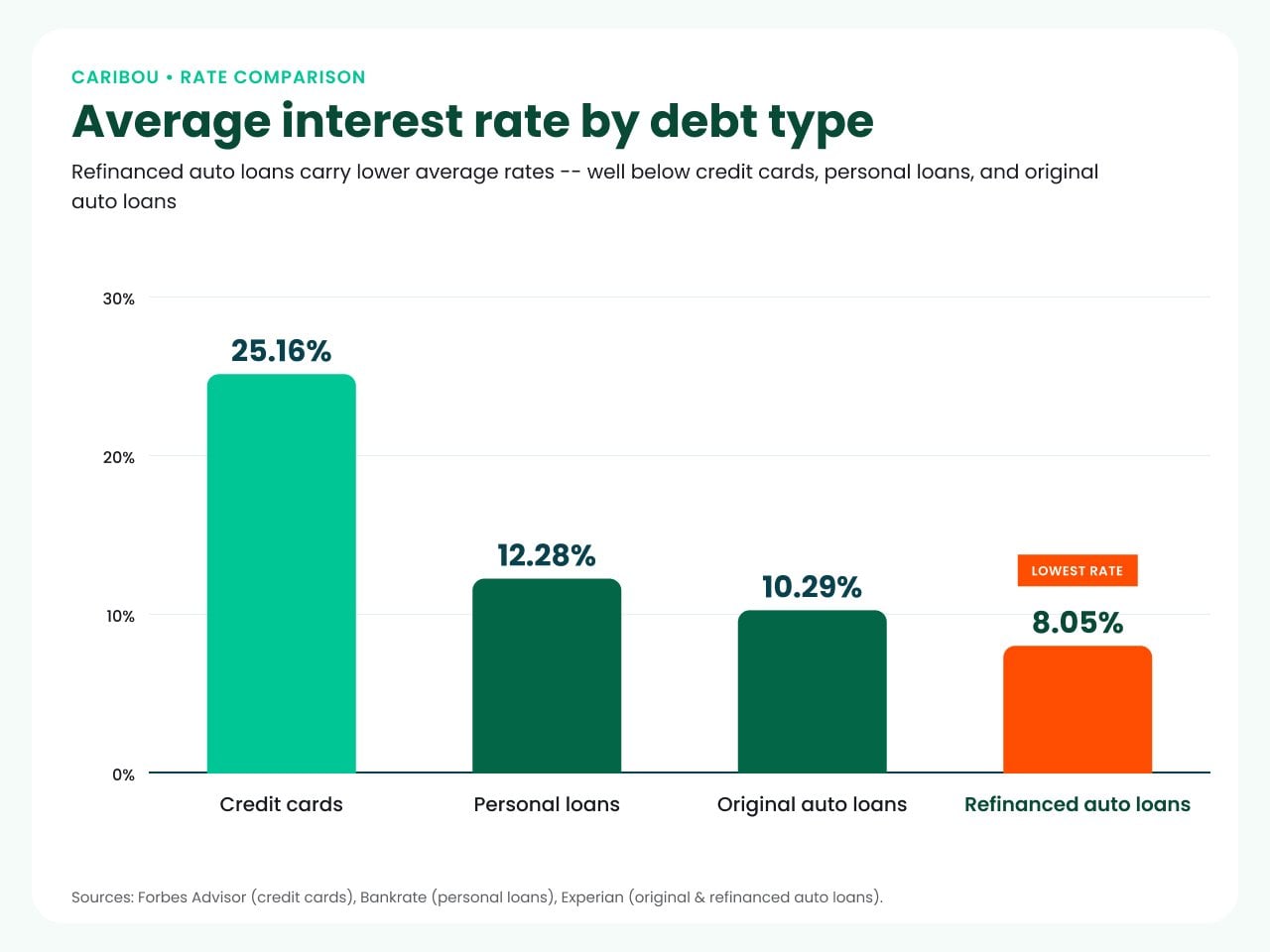
In many cases, it makes sense to focus on high-interest debt first, like credit cards. That’s because credit card interest can grow quickly and make it harder to get ahead. Even a small monthly amount can help if you apply it consistently. Over time, this can reduce the interest you pay and even improve your credit score.
That’s what Omar Pena of California plans to do after refinancing his Chevy Camaro and lowering his car payment by $274 a month. “The savings will definitely help me pay off my other credit cards, which is going to help me reach my credit goals,” he said.
How does a car lower payment impact your debt-to-income ratio
The debt-to-income (DTI) ratio is one of the most consequential numbers that provides a peek into an individual’s financial health, yet many people are unaware of this figure until they apply for a loan.
Lenders want to see that your monthly debt payments are a manageable slice of your income, and that’s what your DTI ratio measures. Refinancing into a lower monthly car payment reduces your DTI ratio, and a lower DTI improves your access to credit. A lower DTI is also key to getting better rates for other loans like mortgages. So if you have a high DTI and a high credit score, and are considering buying a new home, refinancing your auto loan at least six months before you buy could help you qualify for a lower rate.
What starts out as $150 in monthly savings from refinancing your car loan could lead to more borrowing power for years to come.
Be intentional with your savings
Refinancing a car loan can not only save Americans thousands of dollars a year but also have a ripple effect, improving their overall financial health.
Most Americans carry more than one form of debt. Each has its own interest rate, its own minimum payment, its own timeline. But your car loan may be one place to look if debt is stretching your budget. If you can lower your payment, you may be able to free up money and put it toward the high-interest debt that’s costing you the most.
The key is to be intentional. Don’t just lower your car payment. Use the savings to make real progress.
This story was produced by Caribou and reviewed and distributed by Stacker.
