Idaho House passes teachers’ union restrictions, as session adjourns


By: Kevin Richert and Ryan Suppe
Originally posted on IdahoEdNews.org on April 2, 2026
BOISE, Idaho — A last-minute bill restricting teachers’ unions passed the House Thursday afternoon, after surviving two procedural challenges Thursday morning.

The 43-24 House vote sends the heavily amended House Bill 516 to Gov. Brad Little's desk, as lawmakers look to adjourn for the year. Thursday is the 81st day of the 2026 session — and the final day of the session. The Senate formally adjourned for the year at 6:19 p.m.; the House followed suit at 6:29 p.m..
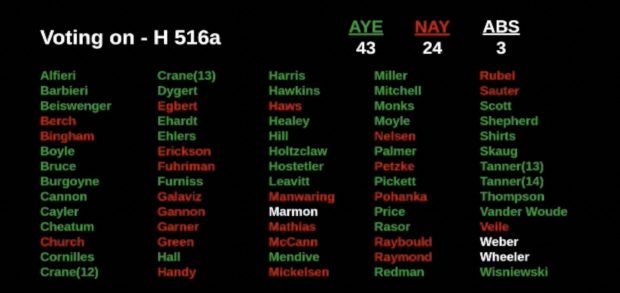
At issue is a controversial proposal that would make it illegal for schools to “use or authorize the use of taxpayer funds to support teachers unions.” Among other things, schools could no longer use their payroll systems to collect union dues, increase teacher pay to cover the cost of union activities, or provide a teacher paid time off for union activities.
These proposals aren’t new — lawmakers have debated them in past sessions, and earlier this session — but the issue came back to life in the waning days of the 2026 session.
On Monday, the Senate transformed a three-page bill on LGBTQ+ instruction into a 10-page union bill. The total rewrite is known in Statehouse parlance as “radiator capping” — taking one part from a car, and building a new vehicle around it. The Senate passed the overhauled bill Wednesday.
During debate over the bill, Rep. Judy Boyle, R-Midvale, downplayed the impact on teachers' unions, which represent educators in 83 Idaho school districts. The bill would simply prevent taxpayer support of teachers union.
Rep. Soñia Galaviz, an elementary school teacher, took a much more dim view of the situation. She cited language that broadly defines "teachers union activities," a definition that includes promoting the union or soliciting membership.
“This will kill the teachers’ association,” said Galaviz, D-Boise. “It will not let us utter a word about it.”
Galaviz attempted to move the bill to the House's amending order — saying it should be extended to cover law enforcement and fire department unions that actively lobby the Legislature. She withdrew her motion after Republicans objected.
Earlier in the day, the eleventh-hour amendment process came under scrutiny in a pair of procedural votes.
First, the House had to vote to accept the Senate’s amendments to HB 516.
House Education Committee Chairman Dale Hawkins, the author of the original LGBTQ+ instruction bill, defended the overhaul.
“Nothing was done sneakily,” said Hawkins, R-Fernwood. “This is a good measure. It does not stop one educator from being involved in unions.”
Boyle also debated in favor of the rewrite. Earlier this year, Boyle sponsored a similar union bill, House Bill 745, which passed the House last month. Sen. Dan Foreman, R-Moscow, refused to bring the bill before the Senate Commerce and Human Resources Committee, prompting the HB 516 makeover.
“The Senate doesn’t do that very often,” she said. “That tells you how upset they were.”
House Minority Leader Ilana Rubel said the entire process has “smacked of shenanigans,” cutting the public out of the process.
“At no point has the substance of this bill … been heard by an education committee,” said Rubel, D-Boise.
Galaviz said the union bill reflects a “continual and steady erosion of trust, of respect,” for what educators do. Every legislative session, she said, “public school teachers hold their breath across the entire state.”
The House voted to accept the amendments on a 41-23 vote, over bipartisan opposition.
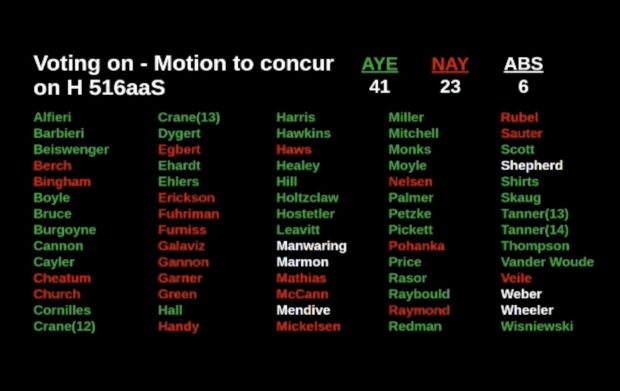
Minutes later, the House rejected an attempt to ship the bill back to House Education for a hearing.
Rep. Lori McCann, R-Lewiston, pushed for the move, noting that House Education has “never had the opportunity” to hear the issue.
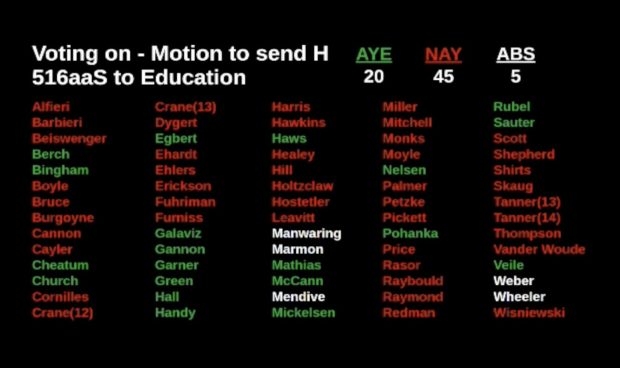
House Majority Leader Jason Monks said the issue received a full public hearing, when the House Commerce and Human Resources Committee considered Boyle’s HB 745. “Let’s just move along with the process,” said Monks, R-Meridian.
McCann’s motion failed on a 20-45 vote.
Thursday afternoon’s vote turns the focus to Little.
The amended HB 516 fell short of two-thirds support in both the House and the Senate — meaning Little would have the support to sustain a veto. However, Little has not vetoed a single bill so far this session.