Nvidia is in peril. Can it survive without Jensen Huang?

By Clare Duffy, David Goldman, Hadas Gold, Lisa Eadicicco, CNN
(CNN) — Nvidia CEO Jensen Huang says he wants to die at his desk. He frequently talks about how integral he is to the foundation of the world’s second-biggest company and the world’s most important AI chipmaker.
Soon, Nvidia may need to learn how to live without its CEO of 33 years.
Huang’s extramarital affair with a customer whom Nvidia is investigating for potential espionage threatens to oust him from the CEO role he has held since he co-founded Nvidia in 1993. The extraordinary revelation Sunday raises the specter of an AI earthquake: An Nvidia without Huang, who helped form the bedrock of AI computing power that fuels the revolutionary technology transforming the global economy.
The investigation has just begun, and Huang’s future remains unclear. So too does the future of Nvidia.
Nvidia without Jensen?
Huang admitted to an extramarital affair Sunday as his company announced it would investigate reports he was the “target of a foreign intelligence effort.” The separate statements came amid growing concern over his relationship with an executive from Singapore-based tech company Megaspeed, Alice Huang.
Several US outlets have reported that American officials suspect Alice Huang, no relation, fed intelligence to China and helped smuggle advanced artificial intelligence chips into the country.
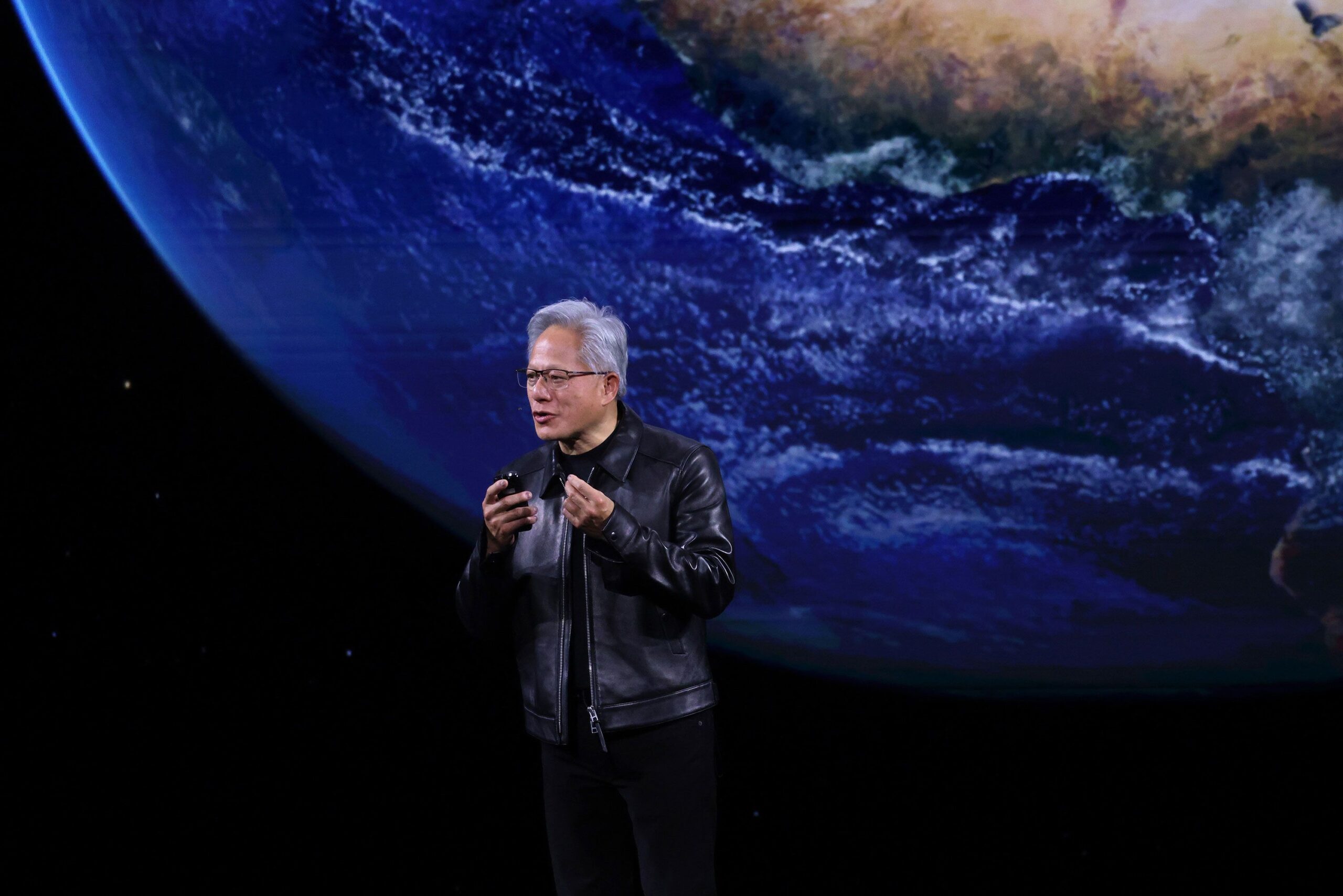
The New York Times first reported on their relationship, showing Alice Huang photographed with Jensen Huang, the silver-haired CEO wearing his signature leather jacket, who has become one of the faces of AI.
The board inquiry is especially striking given Huang’s close relationship with President Donald Trump and central role in advising on AI policy, where he has pushed for fewer restrictions on trade of advanced American technology to China. He traveled with Trump to China earlier this year and the Middle East last year. He was seated next to the president at a White House lunch in September, during which AI and political leaders formed an accord for how the companies should “self-police” for AI risks.
Investors are concerned about Nvidia’s future — and Huang’s potential departure: The company’s stock fell 6% Monday.
“Losing Huang would introduce a lot of uncertainty, particularly given his influence over Nvidia’s strategy, culture, and relationships with major technology companies,” said Ken Mahoney, CEO of Mahoney Asset Management. “The stock would be in even tougher shape than it is now if that were to happen. He is an exceptionally important figure to tech and the AI buildout.”
Jensen = Nvidia
“Our company was built so that I know how to run it. So, for as long as I’m running it, that’s all that matters.”
Three and a half years have passed since Huang gave that quote to Bloomberg, and he has become only more interwoven with the fabric of Nvidia as demand for the company’s AI chips has exploded in value. Today, Nvidia is worth $4.5 trillion — roughly two years after it surpassed a $1 trillion valuation.
Huang’s longevity partly stems from a myth he’s created for himself that extends back to Nvidia’s creation story: He and the company’s co-founders sat at a Denny’s in 1993 and sketched out the business plan for the chip company. According to Huang’s telling, the co-founders told Huang he’d be responsible for running the business to do the stuff they didn’t understand.
Huang also loves to talk about how he repeatedly saved the company from near death — so much that the company’s motto, emblazoned on slide decks and topping presentations, was: “Our company is thirty days from going out of business.”
Nvidia executives who have spoken about Huang talk about a tough, chronically frustrated boss who publicly berates his staff in front of others. Yet Huang also has a disarming sense of humor and some endearing quirks (like not wearing a watch, because the most important time is now.) He’s gotten Nvidia’s staff to be fiercely loyal to him.
Huang prides himself on outlasting his peers. He is fond of poking fun at other CEOs, telling them that when their children are running their companies, Huang will still be running Nvidia. Huang has said he never believed in succession planning, telling podcaster Lex Fridman earlier this year that he hoped to die at his desk.
That Steve Jobs-like reality distortion field extends to the aura he constructed that convinced many inside and outside Nvidia that Huang can tell the future — most notably being spot on (and way early) about the company’s graphics processors serving as the bedrock for AI. That was in 2013, a decade before ChatGPT.
In 2016, Nvidia donated a supercomputer powered by its GPUs to OpenAI.
Whether Nvidia’s success is attributable to Huang’s luck, unique intelligence or both, it’s clear that Nvidia’s success is because of Huang.
The investigation “brings the stewardship of one of America’s most important companies, and the architect of the US AI trajectory, under debate,” Stacy Rasgon, senior analyst covering semiconductors at Bernstein Research, said in a note on Monday.
If Huang isn’t CEO, what becomes of Nvidia?
Nvidia’s board has said it currently has no reason to believe that US national security or Nvidia’s secrets were compromised. And Huang has committed to continuing to lead the company.
Still, the board “absolutely has an obligation to investigate this quite thoroughly” and remove Huang if he were indeed found to have shared private information about the company, said Kathy Harrigan, professor of business leadership at Columbia Business School.
And while Huang and Nvidia may not have publicly discussed succession planning, “a competent board would have had at least two individuals in training, or a pretty good idea about what kind of person they would want to recruit from the outside if it were necessary,” Harrigan said.
“Boards are there to protect shareholders, and they have to see to it that, just in case he gets hit by a truck tomorrow, the company will continue on,” she added.
The board is in a tricky position — it’s obligated to fully investigate the situation, but if the inquiry uncovers evidence of harm to the company, it could increase Nvidia’s exposure to shareholder lawsuits, said Ann Lipton, professor at Colorado Law School at the University of Colorado, Boulder.
Nvidia previously downplayed Huang’s connection to Megaspeed, statements that could come back to bite the company in a potential fraud lawsuit, in which shareholders could seek compensation for the stock’s decline if they can prove that Huang or the company made intentional misstatements about the incident and the risks it posed to Nvidia. Such claims could be filed within days, Lipton said. Shareholders could also seek to sue for breach of fiduciary duty, although those claims could be harder to substantiate.
Currently, the company is at “pretty severe risk” of shareholder litigation, she said.
No business — even one with a singular leader like Nvidia’s — is exclusively dependent on one person, noted Mahoney. Long term, Nvidia could lose a competitive advantage, but demand for the company’s chips won’t evaporate immediately if Huang is ousted.
And despite Huang’s leadership style, Nvidia’s bench is deep. Just like Apple without Steve Jobs, the company can continue without Huang.
“The same is true with Nvidia as it was with Apple: Their competitive advantages extend well beyond one individual,” Mahoney said. “The bigger question is whether a successor could maintain Huang’s strategic vision and ability to anticipate where the industry is heading – and how that new leader could be tested along the way if things become difficult.”
Other analysts echoed that while the investigation creates uncertainty for Nvidia and the surrounding industry in the short-term, it would be unlikely to entirely upend the company’s business.
Major firms buying Nvidia’s chips and software for AI training and data centers are unlikely to slash “their capital spending amid uncertainty around the Nvidia CEO position,” Morningstar Senior Equity Analyst Brian Colello said in an email. However, he added that Huang has played a central role in mobilizing funding for the AI buildout — helping other companies afford to buy his chips — and said the “costs of capital may rise for future investments if perhaps the most prominent CEO in the AI landscape is no longer orchestrating such deals.”
The-CNN-Wire
™ & © 2026 Cable News Network, Inc., a Warner Bros. Discovery Company. All rights reserved.
