Why moving more slowly can help you get stronger

By Dana Santas, CNN
Finishing a set of squats, push-ups or biceps curls with your heart pounding can feel satisfying. But if you rushed to complete all your reps, you might be missing an opportunity to get stronger.
Raising your heart rate is an important marker of cardiovascular exercise, but it doesn’t tell you how well you’re performing strength training. When the goal is to build muscle, how you manage resistance throughout a movement matters most.
Slowing down — by as little as three seconds per rep — can increase the challenge and strength-building capacity while giving you time to notice and improve your form and control.
An important 3 seconds you may be missing
Most familiar strength movements involve two types of muscle action: concentric, when a working muscle shortens as it produces force, and eccentric, when a muscle produces force while lengthening. It’s the eccentric phase that is often overlooked.
Think about a biceps curl. As you bend your elbow to lift a dumbbell, your biceps muscle at the front of your upper arm shortens. As you straighten your elbow to lower it, your biceps lengthens while eccentrically contracting to resist the weight’s downward pull.
Eccentric muscle strength helps you control resistance and decelerate, whether you are lowering a dumbbell or lowering yourself into a chair. Yet most people treat the eccentric phase of an exercise as little more than a quick one-second reset before the next rep.
By slowing down and counting out three seconds as you lower a weight or your body, you can actively train eccentric muscle action in most any resistance exercise. Adding those two extra seconds may make your usual weight feel harder and make you feel less able to complete as many repetitions. As a recent review of eccentric exercise tempo explains, extending the lowering-phase time can increase the effort and fatigue involved.
The added challenge results in increased strengthening, making a slower-lowering tempo a useful way to increase difficulty without heavier weights. A systematic review and meta-analysis in the Journal of Sports Sciences found that longer lowering phases could even produce greater strength gains among experienced lifters.
Slow down to improve control
Slowing your lowering tempo also gives the opportunity to pay attention to how you move and manage loading through your joints. In a squat, for example, a controlled descent lets you focus on coordinating the alignment and movement of your hips, knees and ankles to avoid dropping into a position you cannot control.
When you take your time, you can self-assess using practical checkpoints that help you adjust your strength training practices to be safer and more effective:
- When you squat, can you keep your feet firmly planted and knees tracking over your toes as you descend?
- During a push-up, can you lower your chest and pelvis together without letting your lower back sag?
- As you do a biceps curl, can you move the weight without swinging your torso?
Based on your observations you will know when to reduce or add weight, shorten or increase range of motion, or choose an easier or harder variation.
Match your speed to your goal
All of this said, there is still a place for moving quickly during strength exercises in the context of training to enhance power. Increasing the body’s ability to produce force rapidly requires practicing faster efforts. The American College of Sports Medicine’s updated resistance-training guidance recommends a fast-lifting phase with appropriate loads when training for power.
Performing exercises designed around speed, such as jumps and throws, are not the same as rushing through repetitions to finish a set. And just as the dynamic intensity you would use to throw a weighted medicine ball isn’t appropriate for every exercise in your workout, the three-second lowering cue only applies to select strength movements when your goal is eccentric training.
Three exercises to try 3-second lowering
Choose one or more exercises below to begin practicing eccentric training. Start with two sets of four to eight repetitions, two or three times per week. Modifications and progressions are noted, but you can also adjust intensity by reducing or increasing rep or set count and frequency.
Unfamiliar eccentric exercise can cause soreness, so, if you’re new to this type of training, be sure to introduce it gradually and allow adequate recovery between sessions.
With each exercise, lower smoothly over three seconds, then return at a comfortable, controlled pace. Pay attention to your form, noting the checkpoints mentioned above. Keep breathing as you move. The three-second count should not prompt breath-holding or unnecessary neck and shoulder tension.
Note: Before beginning this or any new exercise program, consult your doctor or physical therapist. Stop if you experience pain.
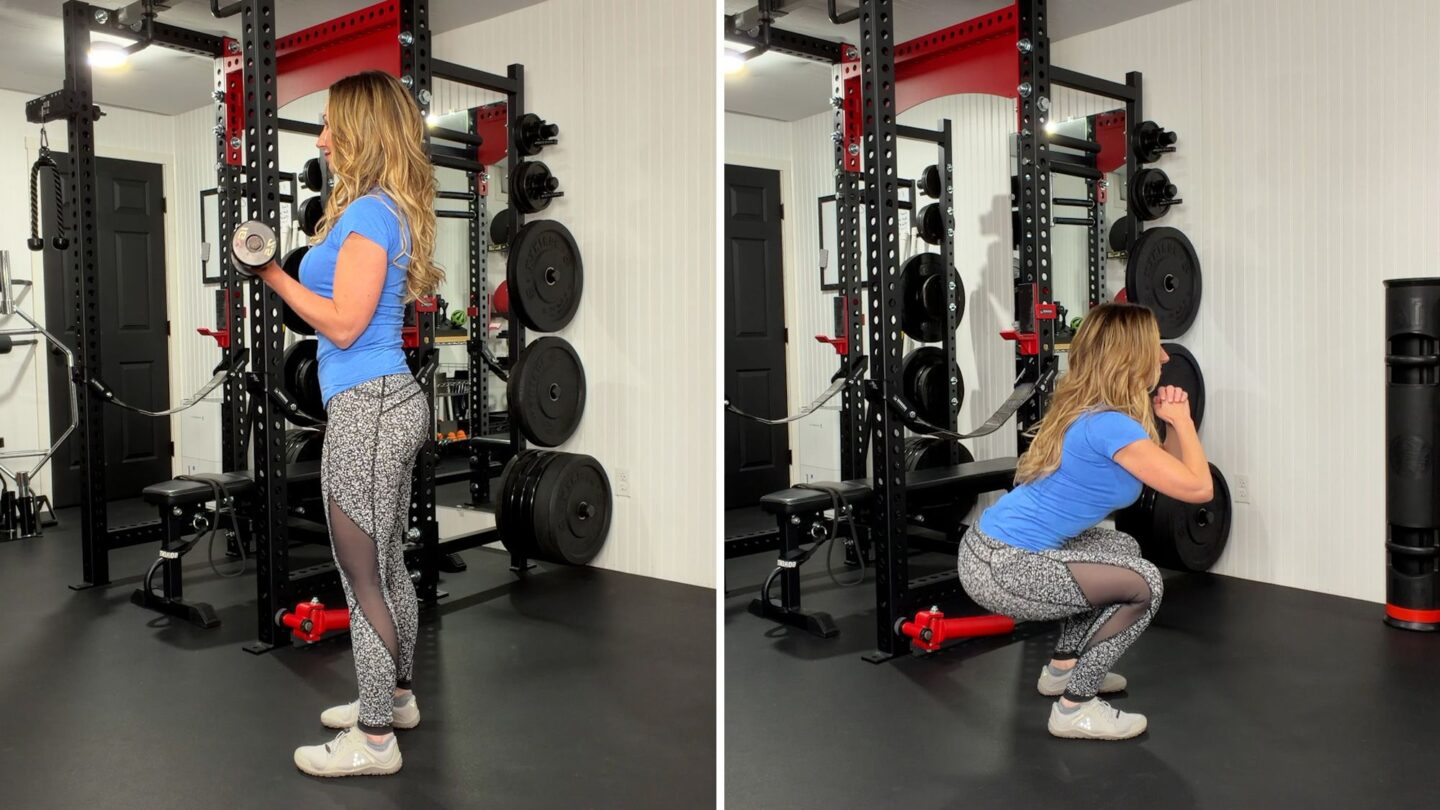
1. Squat
Stand with your feet about hip-width apart. Take a slow count of three to lower into a squat with your hips as close to parallel with your knees as possible. Press through your feet to stand.
Modify: Lower to lightly touch a sturdy chair behind you, then stand. Hold a counter for support if needed.
Progress: Hold dumbbells in each hand or a single dumbbell or kettlebell at your chest.
Why it works eccentrically: As you lower, your quadriceps at the front of your thighs and gluteus maximus muscles in your buttocks lengthen and control the descent.
2. Push-up
From a plank position on the floor, bend your elbows and lower toward the floor through a three-second count, moving your chest and pelvis together. Exhale as you press up.
Modify: Take an inclined position by placing your hands on a counter or higher surface.
Progress: Elevate your legs for a decline push-up position.
Why it works eccentrically: Your pectoral muscles in your chest and triceps at the back of your upper arms elongate during the descent while controlling the speed of the movement.
3. Biceps curl
Stand or sit upright, holding dumbbells at your sides with palms facing forward. Keep your upper arms touching your body as you bend your elbows to lift the weights up toward your shoulders. Take three seconds to lower the weights and straighten your arms.
Modify: Use lighter weights or alternate arms to focus on one side at a time.
Progress: Increase the weight.
Why it works eccentrically: Your biceps and brachialis muscles in your upper arms help bend your elbows and remain active while lengthening to provide support and control as you lower the weights.
Once you are feeling stronger and can maintain the pace and technique, gradually add repetitions, more sets or increase resistance. You do not need to extend the lowering time.
Remember, slower movement does not automatically mean less joint stress, and tempo alone is not a proven injury-prevention strategy. Choosing the right weight, exercise and range of motion for your capacity is important.
The-CNN-Wire
™ & © 2026 Cable News Network, Inc., a Warner Bros. Discovery Company. All rights reserved.
