States that cap rent increases, and where support for rent control is building


In states with rent control, the law limits how much a landlord can raise rent. Those legal caps typically reset every year (and vary by location), but cities and counties within the same state may still have vastly different rent control laws.
Landlords who operate rental properties in areas with these laws can face plenty of frustrating hurdles when raising rent. As operating costs creep up, rent caps can make it harder for them to keep pace with the market. If a landlord doesn’t understand the rules, they could end up refunding excess rent or pleading their case in front of a judge.
On the other hand, for tenants, those same caps can soften the jolt of a renewal increase that might otherwise force them to move to a new rental. That predictability makes it easier to budget for housing costs from one lease term to the next.
TurboTenant looked at the states that cap rent increases, how rent caps and related regulations work, and what those rules could mean for landlords and tenants.
Rent caps and regulations in 8 states
What often gets overlooked is how differently rent control works from one state to the next.
Some states tie rent control to the consumer price index (CPI), regardless of whether a rental is in areas where rents are rising fastest. Before raising rent, landlords in these places typically need to track annual changes and figure out which rules apply.
Note: CPI measures how prices for everyday goods and services change over time, giving states a common way to track inflation.
Washington, Oregon, and California, for example, all cap rent through a statewide formula. New York takes a different approach by applying Good Cause Eviction Laws in NYC, while allowing other municipalities to choose their own approach. In New Jersey and Maryland, rent control laws are common, and Connecticut’s fair rent commissions review tenant complaints about excessive rent increases on a case-by-case basis.
Then there is Massachusetts, which does not have traditional rent control for standard private-market housing, but came close to getting it onto the ballot in 2026.
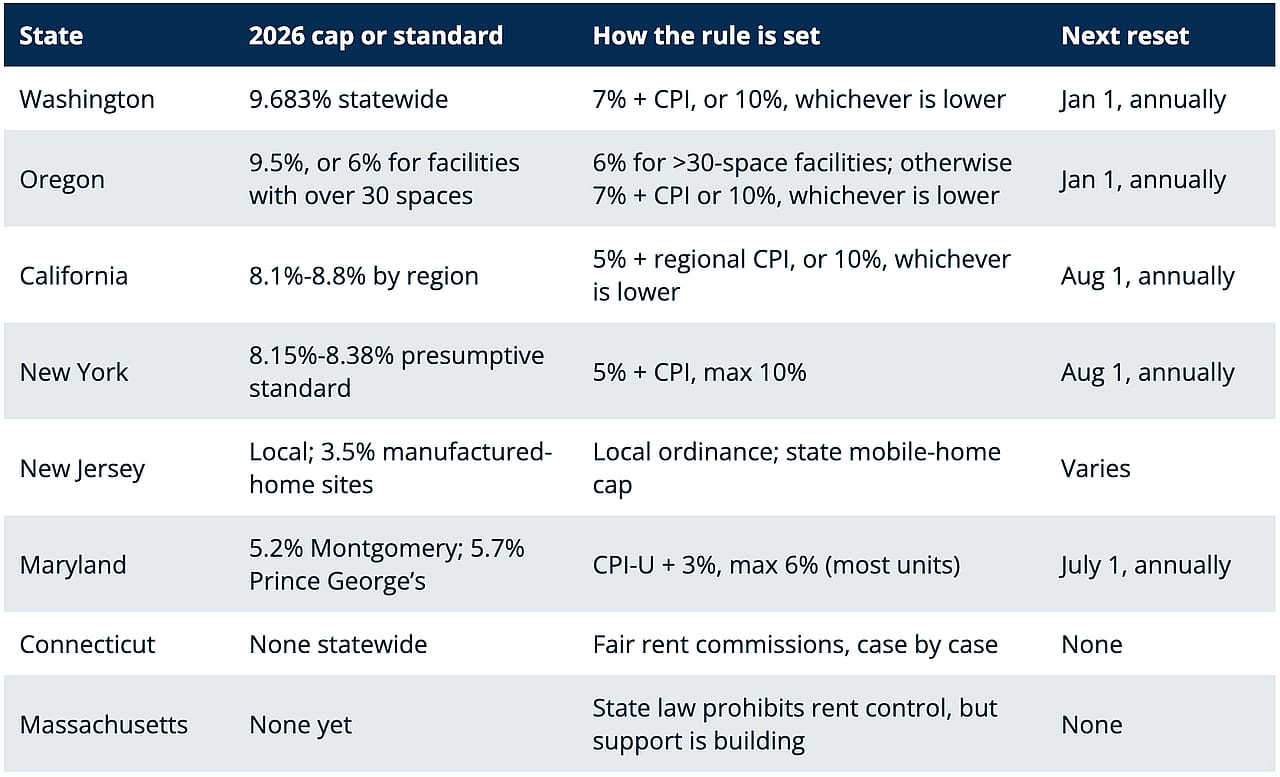
If this all sounds a little murky, use the table below to see which states have rent control in the U.S. today and then dive into the list below for more information about each state’s relationship to rent control.
1. Washington
Washington state’s rent control law took effect in May 2025, and the Department of Commerce set the 2026 cap at 9.683% (7% plus CPI), with a 10% overall ceiling.
The law also affects lease structure. For example, rent for a fixed-term Washington residential lease can’t differ by more than 5% from month-to-month rent for the same unit. Further, landlords must also give tenants 90 days’ notice of a rent increase, up from the old 60-day timeline. That 50% extra runway aims to make a sizable increase less jarring for renters.
A single infraction can trigger civil penalties as high as $7,500 for landlords, with damages for unlawful and excess rent tacked on for up to three months. In its initial round of enforcement in August 2025, Washington saw eight landlords back down from their rent increase notices and return excess money to their tenants.
Landlord associations across the state have objected to rent control, citing concerns about housing investment, supply, and rising property operating costs.
2. Oregon
The state capped Oregon rent increases in 2019 and became the first state in the U.S. to implement a statewide rent control law. From the start, the law didn’t satisfy everyone: Renters argued the cap was too high, while others warned it could raise rents and reduce housing supply.
The Department of Administrative Services corrected the 2026 percentages to 6% for facilities with more than 30 spaces, including manufactured-home parks and marinas, and 9.5% for most other covered rentals. Both numbers are below the 10% maximum Oregon allowed in 2025.
Each year, the department’s Office of Economic Analysis calculates and publishes the maximum allowable rent increase percentages, which go into effect every Jan. 1.
3. California
California’s rent control formula takes a little unpacking. As a baseline, the statewide Tenant Protection Act limits annual increases to 5% plus the regional change in CPI, or 10%, whichever is lower.
But the exact allowable cap depends on the rental’s address and the applicable CPI.
For rentals governed by the statewide cap in Los Angeles, Long Beach, and Anaheim, for instance, landlords can raise rent by up to 8.7% between Aug. 1, 2026, and July 31, 2027, up from 8% the year before. Each year, California recalculates regional caps using April CPI data, and the new limits take effect every Aug. 1.
To add even more nuance, certain single-family homes are exempt from the Tenant Protection Act if the owner isn’t a corporation, a real estate investment trust, or a limited liability company with a corporate member, and the landlord has served the tenant with the correct statutory notice that the unit is exempt.
As far as public reception, tenant advocates have welcomed the measures, while apartment groups argued they wouldn’t fix the housing shortage and could discourage new construction.
4. New York
Since the Good Cause Eviction Law took effect in April 2024, many New York tenants have enjoyed much-needed protection from steep rent increases and lease nonrenewal. Notably, the hot-button law applies automatically in New York City, while other municipalities can choose whether or not to adopt it.
By May 2026, the Division of Housing and Community Renewal (DHCR) listed 19 municipalities outside of NYC that had opted in. Albany joined first in June 2024, followed by Kingston in July. One key difference is how jurisdictions define a small landlord: New York City sets the line at 10 units, while most participating towns use only one.
Good Cause laws don’t set a strict rent cap; instead, they treat increases above 5% plus inflation, or 10% total, as potentially unreasonable.
In essence, this standard means that landlords can still attempt to charge rent higher than the limits discussed, but if the tenant challenges the rent hike, the landlord will need to justify the increase in front of a judge.
Naturally, both sides aren’t quite satisfied: Tenant advocates want broader statewide coverage, while landlord groups oppose limits on rent increases and nonrenewals.
In June 2026, New York City’s rent debate heated up under Mayor Zohran Mamdani, who backed a rent freeze for roughly 1 million rent-stabilized apartments across the Big Apple.
Important legal note: To stay fully compliant, regulated landlords must also include required Good Cause language in New York residential lease agreements, renewals, and certain eviction notices and court filings.
5. New Jersey
Rent control in New Jersey depends largely on local rules. The state Department of Community Affairs tracks which of New Jersey’s 564 municipalities have a rent stabilization ordinance, and more than 100 municipalities regulate rent increases locally.
Since March 2026, state law capped rent increases for covered manufactured-home sites at 3.5% over any 12 months, subject to limited exceptions. For most conventional rentals, however, landlords still need to look toward municipal regulations to determine whether a local cap applies.
Take Passaic, for example. In September 2025, the city reduced its annual base-rent cap for covered units from 6% to 3% (although landlords may add a qualifying prorated property tax increase). The amendment also ended vacancy decontrol for covered units, meaning rent increase limits remain in place even after an old tenant moves out and a new one moves in.
6. Maryland
While Maryland doesn’t have a statewide rent stabilization law, local caps still apply in some jurisdictions. For instance, Montgomery County limits rent increases for covered units to 5.2% through June 30, 2027, based on CPI for all urban consumers plus 3% or 6%, whichever is lower.
In simple terms, allowable rent increases can grow with inflation but cannot exceed 6% in a given year.
One exception is that properties on Montgomery County’s Troubled or At-Risk Properties Report. These properties cannot raise rent until they’re removed from the report, though a landlord who can’t correct the violations may submit a Fair Return application. Montgomery County landlords also cannot increase rent midlease, even on a multiyear lease.
Prince George’s County also has rent stabilization with the same July 1 reset date: 5.7% for most regulated units and 2.7% for age-restricted senior housing in 2026-27.
Renters and tenant advocates in these jurisdictions have pushed for greater stability, while property owners and developers have warned that tighter caps could jeopardize new housing construction.
7. Connecticut
In practice, Connecticut regulates rent by complaint instead of by percentage.
By 2028, municipalities with at least 15,000 residents will have to create or join a fair rent commission, which can limit increases it finds harsh and unconscionable after a tenant complaint. In 2024, proposed hikes of up to $900 a month at one East Lyme apartment complex helped fuel a local push for a fair rent commission.
A 2026 proposal, HB 5092, would have treated increases above the greater of 5% or inflation as excessive in some cases involving recently transferred properties, but ultimately the bill did not become law. For landlords, this means there still isn’t one statewide formula to check before raising rent. Instead, they’ll need to see whether a local fair rent commission has jurisdiction and what rules apply there.
8. Massachusetts (Close, but no rent control)
Massachusetts isn’t like the other states on this list.
As of August 2026, Massachusetts doesn’t allow rent control on ordinary private-market rentals, though the issue nearly made it to voters. The state has had a broad prohibition on mandatory rent control in place since 1994. By November 2025, supporters of a change claimed to have collected over 124,000 signatures for a statewide measure to bring rent control back.
The Supreme Judicial Court ended that effort in June 2026 when it struck the measure from the ballot. The issue was an exemption for certain religious institutions. Justice Frank Gaziano wrote that the petition “relates to religion, religious practices or religious institutions,” and therefore violated Article 48’s ban on such petitions.
Although the measure never reached voters, the push for rent control remains top of mind for landlords and tenants across the state. Lawmakers are also considering separate legislation to let cities and towns adopt local rent stabilization on their own.
Rent control changes constantly. Are you ready?
Knowing the states with rent control is only the start. States and localities update their rules on different schedules, so landlords with rentals in more than one market need the right tools to keep up with their growing pile of day-to-day responsibilities while tracking several limits at once.
Not to mention, states without rent control in 2026 could adopt new restrictions later. To prepare for a potential law change, landlords should update their lease and renewal process accordingly and use a state-specific lease template instead of recycling an outdated generic agreement, year after year.
Before raising rent, landlords should check the current cap or standard that applies to their specific property and the notice rules tied to their rental’s address. Ironing out those details beforehand can help landlords avoid costly mistakes, while tenants will have a much better idea of exactly what to expect come renewal season.
This story was produced by TurboTenant and reviewed and distributed by Stacker.
