Gov. Little Expresses Concern Over Deepening Legislative Cuts


Originally posted on IdahoEdNews.org on February 17, 2026
by Kevin Richert and Ryan Suppe:
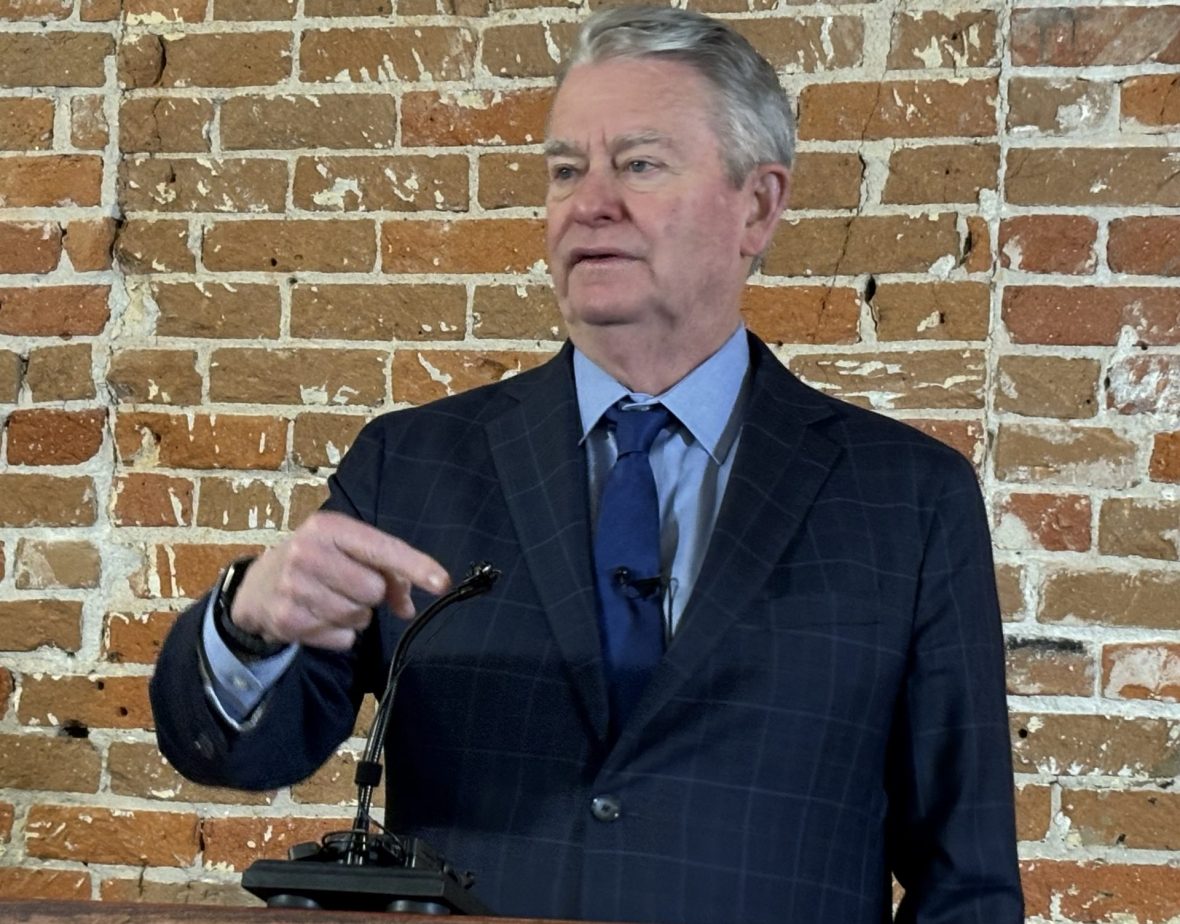
Gov. Brad Little said he’s concerned about the proposed budget cuts coursing through the Statehouse — but also said he has limited options at his disposal.
“They’re the legislative branch,” Little told reporters Tuesday morning. “They get to set the budget.”
Budget-related questions dominated Tuesday’s Idaho Press Club-sponsored event, much as the budget debate continues to overshadow all other topics at in the 2026 legislative session. Little has imposed 3% cuts across most of state government, except for K-12, for this budget year and next year. Legislative leaders are pressing for deeper spending reductions, setting up a showdown between a GOP-dominated Legislature and the Republican governor.
- Little said he is worried about several proposed education-related spending cuts — and unsure of what to expect next:
Lawmakers want to transfer $20 million from Idaho Launch, Little’s signature postsecondary financial aid program. Little has supported a $10 million Launch transfer, for this year’s budget, but not a proposed $10 million transfer for next year. “I’m concerned about anything that’s going to happen to Launch.” - Lawmakers also want to make deeper cuts to higher education — and with K-12, Medicaid, prisons and Idaho State Police exempt from the Legislature’s cuts, two- and four-year schools would shoulder a disproportionate share of the impact. Little said higher ed was one reason why he kept his cuts to 3% — after studying cuts of up to 6%. “(We) rejected (that) out of hand.”
- The Legislature’s Joint Finance-Appropriations Committee on Friday approved $5.5 billion in “maintenance” budgets for next year — which include Little’s 3% cuts and an additional 2% reduction. JFAC leaders have said the committee could increase (or decrease) agency budgets through “enhancement” spending bills, but Little isn’t sure how the committee will reopen and revise spending plans that have already passed the Legislature. “I’m not confident that I know exactly how they’re going to handle that.”
Any budget bills would ultimately go to Little’s desk for his final say. While Little said he will keep all of his options open, he sounded in no way eager to begin vetoing budget bills. Vetoes could add roughly two weeks to a legislative session, since it could take that long for JFAC to agree on a new spending plan, and for legislative staff to rewrite the bill itself. And any delays would come as legislative incumbents — and, presumably, Little himself — are hoping to shift their focus to the May 19 GOP primary.
Little also said the pushback over spending, and legislators’ desire to put an imprint on the budget, came as no surprise.
“I knew it was going to be a bit of a rodeo,” he said.
Little spoke Tuesday about two other education topics.
Career-technical education. Little also said he’s worried cuts to career-technical education could undo work that state education leaders put into expanding capacity in recent years.
In 2023, state superintendent Debbie Critchfield secured $45 million for rural CTE programs. Last year, Little obtained $10 million to build CTE capacity at community colleges. And the Legislature has been “all in on CTE” the last five years, Little said.
Last week, Little’s budget chief, Lori Wolff, highlighted the impact of cuts in a memo to JFAC. A 5% cut would defund 164 CTE programs in K-12 schools, Wolff wrote. And budget reductions for community colleges would be closer to 7% because of the CTE cuts.
Again, however, Little pointed to legislators’ collective role in the budgeting process.
“My job is to submit … a stable, balanced budget that is fundamentally good into the future and then react to their questions to agencies,” Little said.
Immigration. Little also weighed in on a bill introduced last week that would direct state education agencies to collect data on the number of undocumented immigrants in Idaho public schools.
The House Education Committee introduced House Bill 656 Wednesday. Rep. Steve Tanner, R-Nampa, is the sponsor. It’s among a suite of immigration-related proposals backed by a group of about a dozen GOP lawmakers.
The governor appeared skeptical of burdening public school trustees with collecting immigration data, noting that he spoke with school board members Monday. Idaho School Boards Association members are in Boise this week for the advocacy group’s annual “Day on the Hill” event.
“They’ve got a lot of things to do,” he said of trustees. “Until I see how (the bill is) drafted, I just have to see what the consequences of it are.”
HB 656 would direct the State Board of Education to collect “aggregate” data on the immigration status of students in public schools, colleges and universities. No “personally identifiable information” would be collected, according to the bill.
Opponents argued last week that it would target a “vulnerable” population. On Feb. 6, agents with Immigration and Customs Enforcement (ICE) arrested a father while he was dropping off his child at a Boise daycare, the Idaho Statesman reported.
Asked about immigration enforcement’s effect on children, Little responded that the state’s pact to collaborate with federal immigration authorities is focused on “dangerous criminals.”
“We’re in total agreement there,” he said.
Ban on LGBTQ+ instruction clears House
The House overwhelmingly supported a bill banning public school classroom instruction on sexual orientation and gender identity.
Rep. Dale Hawkins said his bill would remove a provision that was mistakenly left in a law enacted last year. The law now allows instruction that’s “age appropriate or developmentally appropriate for students in accordance with state standards.”
House Bill 516 would remove the age-appropriate allowance, effectively banning all instruction on sexual orientation and gender identity. “What we are here today to do is to remove this line that has brought confusion because it didn’t belong in the bill in the first place,” said Hawkins, R-Fernwood.
The House approved the proposal nearly along party lines. Rep. Jack Nelsen, R-Jerome, joined nine House Democrats in opposition.
Rep. Chris Mathias, a Boise Democrat, argued that the bill would remove an “enumerated right” of parents to opt in to instruction that’s age-appropriate. Last year, the Legislature passed a law creating a parental opt-in for sex education — including instruction on sexual orientation and gender identity.
But HB 516 would disallow this parental consent, including for lessons on Little v. Hecox, the U.S. Supreme Court case weighing whether Idaho can bar transgender girls from competing in female sports, Mathias said.
“It’s reasonable to conclude that this bill, if we pass it, is going to be an unforced error of epic proportions,” he said.
The bill now heads to the Senate.
Also Tuesday, the House passed a bill requiring the Professional Standards Commission — the state’s educator ethics panel — to report to law enforcement allegations of criminal behavior by teachers and administrators.
Three Boise Democrats opposed House Bill 635 — House Minority Leader Ilana Rubel, Assistant Minority Leader Steve Berch and Minority Caucus Chair Monica Church.
The bill also goes to the Senate.
New bill would 'streamline' school facility permitting
A new bill would nix the requirement that public school districts get state or local regulator approval of a building project before advertising contract bids.
The bill “streamlines” the permitting process for school facilities, according to its statement of purpose. The legislation is sponsored by Rep. Brent Crane, R-Nampa, and Sen. Ben Toews, R-Coeur d’Alene.
It would also require that permitting authorities complete an initial plan review of public school buildings within 30 days.
Special education funding proposal clears its final hurdle
Over some objections, the Senate passed a nonbinding memorial urging the federal government to increase special education spending.
The memorial urges the feds to cover 40% of special education spending — making good on the commitment Congress made with its 1975 Individuals with Disabilities Education Act.
The feds cover about 12% of Idaho’s special education budget.
The brief debate focused on federal debt — and the state’s reliance on Uncle Sam.
“Federal money is actually real money we all have to pay,” said Sen. Brian Lenney, R-Nampa, debating against the memorial.
The memorial’s sponsor, Sen. Van Burtenshaw, R-Terreton, said the obligation for special education, and supporting 41,200 Idaho students, has simply fallen to the state and local property taxpayers.
The memorial passed on a voice vote — after another opponent, Sen. Christy Zito, R-Hammett, made an unsuccessful push for a recorded vote.
The House has already passed the memorial, which does not have to go to the governor. Tuesday’s Senate vote represented the final action on this measure.