Idaho has $1.3 billion in rainy-day funds. Should that money help public schools?


Originally posted on IdahoEdNews.org on March 2, 2026
By Ryan Suppe, Idaho Ed News:
BOISE, Idaho — Faced with a revenue shortfall heading into the legislative session, state leaders had three options to balance the budget: Reduce spending, tap reserves or restore tax revenue.
The third option is unlikely in the GOP-dominated Legislature, which has overwhelmingly supported fast and furious tax cuts in recent years. But Democratic and Republican lawmakers this session have pushed for the second option, particularly as the impact of cuts comes into focus.
Tapping the stockpile of state reserves could prevent budget cuts in the short term — including for public schools. Since the Great Recession, Idaho lawmakers and governors have socked away $1.3 billion in rainy-day funds, about 23% of state general fund spending.
In a Feb. 12 press conference, Democratic leaders proposed spending $533 million in rainy-day funds to avoid cuts. Some Republicans, including Rep. Ben Fuhriman of Shelley, have also said they support using some of the reserves to bridge the revenue gap.
But Republican Gov. Brad Little and the GOP chairmen of the Legislature’s powerful budget-setting committee want to preserve this money for a possible economic downturn in the future. Idaho’s economy continues to grow, and spending rainy-day funds could harm the state government’s stellar credit rating, they said.
“When the economy is one of the top economies in the nation, that is not the time to be digging into our reserves,” said Sen. C. Scott Grow, R-Eagle, co-chair of the Joint Finance-Appropriations Committee.
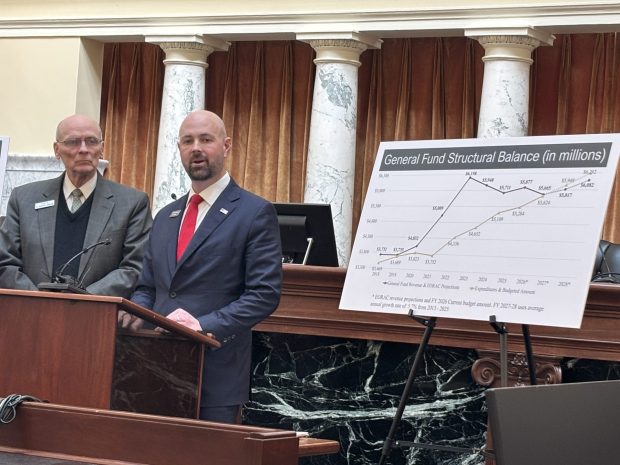
Lawmakers to vote on option one — reducing spending
Last year, the Legislature and governor enacted a suite of tax cuts and credits that reduced the state’s revenue by $453 million annually. At the same time, taxes that were still expected to come in started to miss projections.
By late summer, the governor’s office sounded an alarm. Little ordered most state agencies — excluding K-12 public schools — to cut their spending by 3% and to cancel any requests for budget increases during the 2026 legislative session.
Even after the governor’s cuts, the state faced a $40 million deficit for the current fiscal year, which ends June 30, and a $555 million shortfall next fiscal year, which starts July 1. This didn’t include the projected $155 million hit from conforming to federal tax changes in the One Big Beautiful Bill.
During his State of the State address Jan. 12, Little proposed more than $850 million budget cuts, reversions and transfers across both fiscal years — most of which would be one-time and aimed at bridging the shortfall until revenue rebounds.
Revenue has since improved. Tax collections are now tracking $112.6 million higher than projections for the fiscal year, according to the Legislative Services Office (LSO).
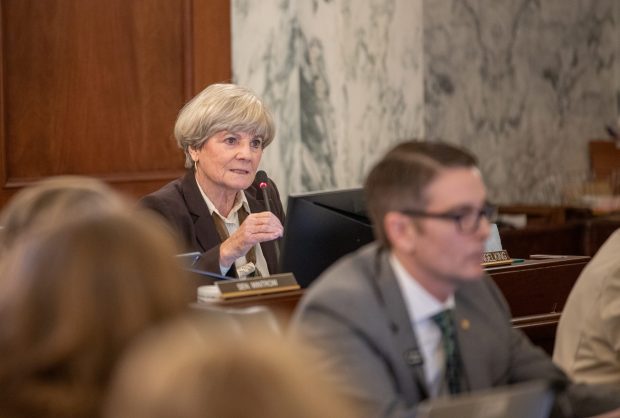
But JFAC’s co-chairs are moving forward with deeper, ongoing spending cuts. They argue the cuts would ensure the state’s budget is “structurally balanced” and expenses line up with revenue. The House and Senate in the coming days and weeks will vote on additional 1% cuts this fiscal year and 2% next fiscal year.
Colleges and universities would bear the brunt of the cuts, and layoffs and program reductions are already under way. Public school leaders are also preparing to cut their budgets or ask for new supplemental levies, even though K-12 is mostly exempt from both the governor’s and JFAC’s cuts. State funding hasn’t kept pace with rising costs to operate schools.
“This is very disturbing, and this doesn’t need to be,” Sen. Janie Ward-Engelking, a Boise Democrat and JFAC’s longest-serving member, said during a recent committee debate on the cuts. “We have reserve funds. We have money. We could fix this.”
Idaho saves more than most other states
Idaho last year ranked in the top 10 nationally for rainy-day funds, according to a study by Pew Charitable Trust. The study, published in October, calculated how many days a state could operate on just its rainy-day funds. Idaho ranked eighth with 87.2 days. Washington was 49th with 12.8 days.
Rep. Josh Tanner, JFAC’s House co-chair, points to Idaho’s westerly neighbor as a cautionary tale. Washington lawmakers just passed the state’s first income tax after “borrowing from any stabilization fund they had,” Tanner, R-Eagle, told reporters during a Feb. 19 news conference. “They were unwilling to make hard choices, hard decisions to actually reel in their budget.”
Amid a deficit, the Washington State Legislature is considering a 9.9% income tax on households that earn more than $1 million, among other budget proposals. But the tax hasn’t passed the full Legislature, only the Senate, and it would take effect in 2029.
Idaho, on the other hand, has cut income taxes five times since 2021. Altogether, the cuts cost the state $4 billion in revenue over four years, according to the Idaho Fiscal Policy Center, a nonpartisan research group that’s been critical of state tax cuts, arguing they will cripple funding for services.
For Tanner, reducing revenue and giving money back to taxpayers is the goal. “We were growing in revenue at a massive rate,” he said. “We were trying to bring that revenue back down.”
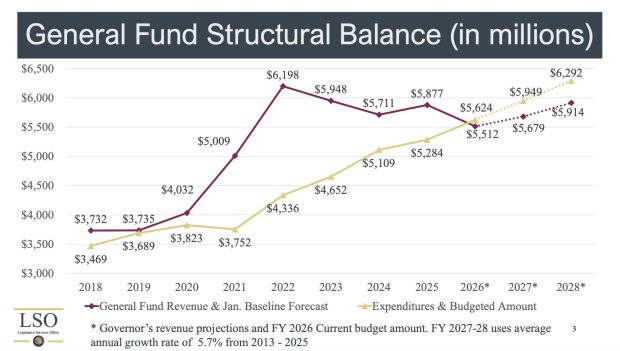
State revenue went from $3.7 billion in FY 2018 to a record $6.2 billion in FY 2022 amid population growth and a surge during the COVID-19 pandemic. In January, JFAC set a FY 2027 revenue target at $5.8 billion, which was 2.4% higher than a projection from the governor’s office.
Amid increasing revenue since the Great Recession, state spending has remained conservative, however. And state leaders bolstered rainy-day funds.
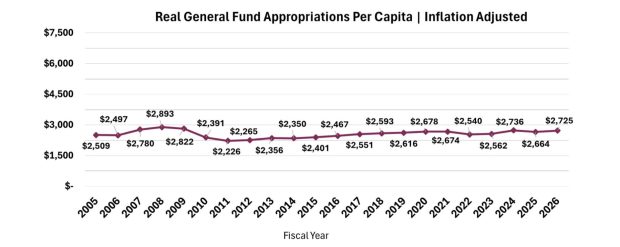
State general fund spending increased 0.4% per year, on average, since FY 2005 when adjusting for inflation and population growth, according to a study by LSO, a nonpartisan agency that supports the Legislature. But inflation-adjusted spending hasn’t returned to its two-decade high point in FY 2008, before the Great Recession.
After the state exhausted its reserves during the recession, GOP leaders have since put away $1.3 billion in rainy-day funds. If you include the fund balance — what’s left over on the bottom line after budgeted appropriations — total reserves were $1.72 billion, or about 31% of general fund spending, when lawmakers adjourned last year’s session.
But using rainy-day funds now would only be a temporary fix to keep services fully funded after the string of tax cuts. Grow compared it to the way Congress operates — spending money that’s not backed by ongoing revenue.
“Let’s right-size the budget, and then when we do have a recession or a challenge, then we can deal with it appropriately,” Grow said. “That’s what those funds are reserved for.”
AAA credit rating benefits ‘whole state’
While the governor’s office is fighting JFAC’s plan for additional budget cuts, Little agrees with the budget co-chairs that rainy-day funds should be preserved for economic recession.
The second-term governor also said that spending rainy-day funds could harm the state’s credit rating. Idaho is one of more than a dozen states with the highest grade, AAA, from the three major rating agencies.
Credit ratings assess state governments’ ability to repay debt. Higher ratings indicate lower risk to investors, leading to more favorable interest rates on borrowing.
Idaho takes on less debt than most other states. It has the second-lowest total debt, and it’s 47th in debt per capita, according to national rankings from the Reason Foundation, a libertarian think tank. But on Feb. 17, Little told reporters that Idaho’s strong rating benefits “the whole state.” It helps local governments more easily borrow money as well, he said.
This is true for public schools that issue bonds to finance major building projects. While school districts can be rated separately when they issue bonds, they typically use the state’s credit enhancement program. It allows districts to issue bonds backed by the state’s AAA rating, lowering interest costs.
“It took us a long time to get a AAA credit rating, and we don’t want to give that up,” Little said.
But this benefit is useful to public school districts so long as they can pass bonds, and that’s becoming increasingly difficult. Idaho is one of two states that requires supermajority voter approval for bonds. In 2023 and 2024, the Legislature and Little have cut in half — from four to two — the number of times per year that districts can hold elections.
From 2001 to 2012, school bonds passed at a 58.4% rate, according to an EdNews analysis. From 2013 to 2023, the success rate fell to 42%. In the two years since the number of election dates were cut, just one of 12 bond measures have passed.
“A concern and a worry that I have is any bonds being passed from here on out,” state superintendent Debbie Critchfield, a Republican, told EdNews in a recent interview. “With the threshold that they have anyway, (bonds are) going to be among the most challenging efforts that our districts make in the coming years.”
What about the third option — restoring taxes?
When state leaders forgo tax revenue and protect their savings it means less money is available for public schools. And unlike the state, public schools don’t have many levers they can pull to move revenue up or down.
Nearly 87% of public school funding comes from the state, while 10.5% comes from voter-approved bonds and levies and 2.7% comes from the federal government.
Some public school advocates, meanwhile, haven’t given up on the third option to balance the state’s budget — restoring taxes — which could also spare public education from cuts.
And they’re invoking Shakespeare to plead their case.
“To thine own self be true,” wrote TOADS, a nonprofit composed of current and former public school educators and administrators, in a recent news release.
The TOADS (Totally Optimistic Advocates Dedicated to Students) point to 89 state special interest tax exemptions, which write off about $2.8 billion a year that could help public schools and other agencies.
The maxim from “Hamlet” urges state leaders — and the media — to look inward. “Are we ready to publicly admit Idaho’s agencies cannot be properly financed until we restore some of the tax base?”

Rep. Steve Berch, D-Boise, has called for a review of tax exemptions for years. House Minority Leader Ilana Rubel, D-Boise, is sponsoring a bill this session that would direct the Legislative Services Office to annually review exemptions and recommend whether they should continue. The House Revenue and Taxation Committee introduced the bill last week.
The legislation is among an assembly of Democratic budget proposals, which also call for restoring or pausing some of last year’s tax cuts.
After the state voluntarily reduced revenue for five years, people who rely on services will “pay the price,” said Senate Assistant Minority Leader James Ruchti, D-Pocatello.
“The Idaho Legislature blew it,” he said.