Idaho House Committee advances two Bills amending library ‘harmful materials’ law

Originally posted on IdahoEdNews.org on March 12, 2026
By Ryan Suppe and Kevin Richert
BOISE, Idaho — Two bills that would amend the state’s “harmful materials” library law are heading to the full House.
The House State Affairs Committee passed the bills Thursday.
Sponsored by Rep. Jaron Crane, R-Nampa, and backed by Attorney General Raúl Labrador’s office, the bills would align Idaho’s law with recent federal court rulings. The Children’s School and Library Protection Act, which Idaho lawmakers enacted in 2024, imposes penalties on libraries and schools that don’t restrict material deemed “harmful” to minors.
The recent court rulings include a Texas decision that found regulating library books is a form of government speech — not a regulation of private speech. The U.S. Supreme Court declined to hear the case, allowing the Fifth Circuit Court of Appeals’ decision to stand.
“In public schools and public libraries, the State of Idaho is exercising its own First Amendment rights through its selection of curriculum and library materials,” reads House Bill 819’s statement of purpose. “Those choices constitute ‘government speech.’”
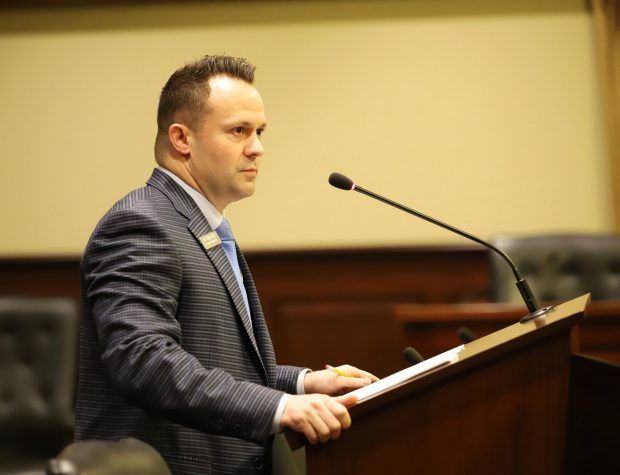
Most people who testified during a public hearing Thursday opposed HB 819. This included representatives from the city of Boise, Idaho Library Association, Community Library in Ketchum and Library Alliance of North Idaho.
Kathy Griesmyer, Boise’s director of policy and government affairs, said the bill “inappropriately” asserts that the “government speech doctrine” — a Supreme Court precedent that holds the government can express the views it favors — allows the state to “regulate private expression” by censoring library material.
“Applying the government speech doctrine to public libraries would fundamentally undermine the role of the public library and society, and instead allows a legislature to decide what is suitable reading material for all library users,” Griesmyer said.
Michelle Lippert of the Library Alliance of North Idaho argued that a proposed new definition of “sexually explicit” material is broad and will have a “chilling effect” on library collections. “People often avoid lawful speech or materials out of fear of punishment,” Lippert said. “Libraries may remove or avoid perfectly lawful books simply to avoid risk.”
The House State Affairs Committee voted 10-2 to advance HB 819. Reps. Stephanie Mickelsen, R-Idaho Falls, and Annie Henderson Haws, D-Boise, opposed it.

“I want our Idaho kids to have the ability, through the guidance of their parents, to explore ideas, to develop empathy for people that are different than themselves, that may have different experiences,” Haws said. “I see this as an additional step toward censoring particular ideas in our state.”
No committee members other than Crane, the sponsor, debated in favor of the bill.
Michael Hon, a Meridian resident and former city council candidate who led an unsuccessful effort to dissolve the Meridian Library District, supported the bill.
“What librarians seem to forget is that taxpayers are the ones that pay their salaries, keep their doors open, keep their lights on,” Hon said. “I would guarantee that a large percentage of taxpayers would not approve of this type of material in the libraries.”
State Affairs members also passed House Bill 795, a less controversial proposal that would remove a clause in the existing law that’s part of a provision shielding content with “serious literary, artistic, political or scientific value.”
Currently, the provision reads: “Nothing herein contained is intended to include or proscribe any matter which, when considered as a whole, and in the context in which it is used, possesses serious literary, artistic, political or scientific value.”
HB 795 would remove “in the context in which it is used.”
Michael Zarian, solicitor general for Labrador’s office, said removing this phrase responds to the Ninth Circuit Court of Appeal’s recent decision on Idaho’s library law. The federal court partially reversed a district court decision upholding the law.
In January, the Ninth Circuit ruled that a coalition of private schools and libraries and their patrons showed a “likelihood of success” because the bill’s context clause is “overbroad on its face” and threatens to regulate expressive activity, EdNews previously reported.
Lance McGrath, president of the Idaho Library Association, said the group was neutral on HB 795 while it opposed HB 819.
Both bills now head to the full House.